

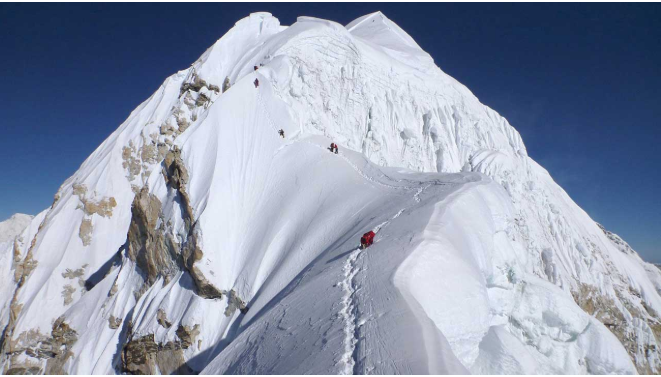

The Nepal Himalayas offer far more than popular trekking routes. For experienced mountaineers, the country’s remote valleys and high peaks provide opportunities to undertake serious expeditions in some of the world’s most dramatic mountain environments. Among these objectives, the Himlung Expedition and Baruntse Expedition are notable for their demanding terrain, remote settings, and rewarding Himalayan landscapes.
Both mountains require careful preparation and a strong understanding of high-altitude climbing. However, they offer distinctly different experiences in terms of location, approach, climbing conditions, and overall expedition character.
Himlung Expedition
The Himlung Expedition takes climbers to Himlung Himal, a magnificent peak located in the remote Nar-Phu region of north-central Nepal. Rising to approximately 7,126 meters, the mountain offers an impressive high-altitude climbing experience while also providing access to one of the less-traveled parts of the Himalayas.
The journey to Himlung is an adventure in itself. Climbers travel through the Manaslu region and eventually enter the remote Nar and Phu valleys. These valleys are known for dramatic landscapes, ancient settlements, Buddhist traditions, and a remarkable sense of isolation.
The approach gradually moves from lower valleys into increasingly rugged mountain terrain. As the altitude increases, forests give way to alpine landscapes, glaciers, and snow-covered peaks. This gradual progression also provides valuable opportunities for acclimatization before the climbing phase begins.
The mountain itself requires technical climbing skills and careful route management. Climbers should be prepared for steep snow and ice, changing weather, cold temperatures, and the physical demands associated with high altitude.
Key Points of Himlung Expedition
- Mountain: Himlung Himal
- Elevation: Approximately 7,126 meters
- Location: Nar-Phu region, north-central Nepal
- Difficulty: Challenging high-altitude expedition
- Major attraction: Remote Himalayan environment and high summit
- Approach: Through the Manaslu and Nar-Phu regions
- Terrain: Glaciers, snow slopes, rocky sections, and high-altitude terrain
- Best suited for: Experienced trekkers and mountaineers
- Important requirements: Acclimatization, physical conditioning, technical climbing ability, and appropriate expedition equipment
One of the defining qualities of the Himlung Expedition is its combination of mountaineering and exploration. The journey through Nar-Phu allows climbers to experience a remote Himalayan culture before entering the more demanding high-mountain environment.
Baruntse Expedition
The Baruntse Expedition is another outstanding Himalayan climbing adventure. Baruntse stands at approximately 7,129 meters and is situated in eastern Nepal, between some of the country’s most impressive mountain landscapes.
The mountain lies in the Makalu-Barun region, an area renowned for its spectacular valleys, glaciers, rugged ridges, and dramatic Himalayan peaks. Its location gives climbers an opportunity to experience a remote and exceptionally scenic part of Nepal.
The approach to Baruntse generally involves trekking through the remote Hunku Valley before reaching the high mountain environment. The route offers a gradual transition from forests and alpine valleys to glaciers and snow-covered terrain.
Baruntse is particularly appealing to mountaineers seeking an intermediate step toward more demanding Himalayan peaks. Although it should never be underestimated, the expedition provides opportunities to develop and apply important skills such as glacier travel, rope work, crampon technique, and movement on steep snow and ice.
The climb requires careful acclimatization and a well-organized expedition strategy. Weather, altitude, snow conditions, and route safety can all influence the summit attempt.
Key Points of Baruntse Expedition
- Mountain: Baruntse
- Elevation: Approximately 7,129 meters
- Location: Makalu-Barun region, eastern Nepal
- Difficulty: Challenging
- Major attraction: High-altitude climbing in a remote Himalayan environment
- Approach: Through the Hunku Valley
- Terrain: Glaciers, snow slopes, ice, and high mountain ridges
- Best suited for: Experienced mountaineers and serious high-altitude trekkers
- Important requirements: Strong physical fitness, acclimatization, technical climbing skills, and suitable expedition equipment
The surrounding scenery is one of the expedition’s greatest rewards. Baruntse is surrounded by spectacular peaks and remote valleys, creating a wilderness atmosphere that is difficult to find on Nepal’s more established trekking routes.
Himlung vs. Baruntse Expedition
Although both expeditions involve peaks of approximately 7,100 meters, their experiences are quite different.
The Himlung Expedition is characterized by its remote location in the Nar-Phu region and the cultural experience provided by the ancient Himalayan settlements along the approach. It is particularly appealing to climbers who want to combine a serious mountain expedition with exploration of a less-visited region.
The Baruntse Expedition offers a different setting in the eastern Himalayas. The journey through the Hunku Valley and the Makalu-Barun landscape provides extraordinary wilderness scenery, while the climb itself offers demanding snow and ice terrain.
Both objectives require more than physical strength. Successful expeditions depend on acclimatization, sound decision-making, appropriate equipment, experienced leadership, and the ability to adapt to changing mountain conditions.
Best Season for the Expeditions
Spring and autumn are generally the principal climbing seasons in Nepal. Spring usually provides favorable conditions for high-altitude expeditions, while autumn follows the monsoon and can offer clearer skies and good visibility.
Conditions at elevations above 7,000 meters remain unpredictable even during the preferred seasons. Strong winds, snowfall, extreme cold, and changing snow conditions can affect climbing schedules.
A flexible itinerary is therefore essential. Expedition teams should be prepared to spend additional days at base camp or higher camps when weather conditions do not allow a safe summit attempt.
Preparation for a 7,000-Meter Expedition
Preparation for either expedition should begin well before arriving in Nepal. Climbers need excellent cardiovascular fitness, strong endurance, and the ability to perform for extended periods in cold and high-altitude environments.
Previous experience with high-altitude trekking and technical climbing is highly valuable. Climbers should also be familiar with essential equipment such as crampons, ice axes, harnesses, ropes, helmets, and appropriate high-altitude clothing.
Acclimatization is one of the most important elements of a successful expedition. The body needs time to adjust to reduced oxygen levels, and a properly planned schedule can help reduce altitude-related risks.
Mental preparation is equally important. High-altitude expeditions can involve long waiting periods, difficult weather, physical exhaustion, and unexpected changes to the itinerary. Patience and sound judgment are essential qualities for every expedition member.
Responsible Mountaineering
Remote Himalayan expeditions also carry an environmental responsibility. Climbers should minimize waste, avoid unnecessary damage to fragile mountain environments, and follow local conservation requirements.
Respect for local communities and traditions is equally important. The approach routes pass through culturally significant regions, and responsible interaction with local people helps preserve the character of these remote destinations.
Conclusion
The Himlung Expedition and Baruntse Expedition offer two exceptional opportunities for mountaineers seeking serious Himalayan challenges beyond the more familiar trekking routes. Himlung combines a demanding high-altitude climb with an unforgettable journey through the remote Nar-Phu region, while Baruntse provides an impressive expedition experience amid the spectacular wilderness of the Makalu-Barun landscape.
Neither mountain should be approached casually. Both demand careful preparation, strong physical conditioning, appropriate technical skills, effective acclimatization, and experienced expedition support. Yet for properly prepared climbers, the rewards extend far beyond reaching the summit.
From remote Himalayan valleys and ancient mountain communities to glaciers, snow-covered ridges, and vast panoramic landscapes, a Himlung or Baruntse expedition can become one of the most memorable adventures of a mountaineer’s career.